Sunday, August 17, 2025

Spectrum Leadership Institute and ALA Annual Conference & Exhibition

This past year, I was honored to be one of the 2024-2025 American Library Association (ALA) Spectrum Scholars! The ALA Spectrum Program provides scholarships to diverse and distinguished students pursuing their graduate degrees in library and information science. As part of the scholarship, I received assistance to attend the Spectrum Leadership Institute (SLI) at the ALA Annual Conference and Exhibition in Philadelphia, Pennsylvania. 

Cindy Hohl

The SLI was a 3-day institute, where we attended sessions such as Things I Didn’t Learn in Library School; Cover Letters, CVs, and Interviewing; and Professional Development. We heard from various Spectrum Alumni, such as Cindy Hohl, 2024-2025 ALA President. Sam Helmick, the 2025-2026 ALA President, spoke with us as well. I learned a lot at the SLI, and it was wonderful to meet other Spectrum Scholars and alumni!

Receiving my SLI Completion Certificate
Photo courtesy of ALA

In addition to the SLI sessions, there were numerous sessions to attend at ALA Annual, including talks and poster sessions related to public, school, and academic librarianship. 

ALA Annual

The Library Marketplace had many exhibitors, demos, author signings, and talks. There was so much going on, it was impossible to attend everything! Some of the sessions I went to included the Stonewall Book Awards, and talks with featured speakers, including George Takei, Grace Lin, and Geena Davis. In addition to the conference, I enjoyed exploring Philadelphia! Overall, I had a wonderful experience attending the SLI and ALA Annual, and I hope to contribute back to the Spectrum community and attend ALA Annual again in the future.
George Takei

Sunday, August 4, 2024

Community Garden

My fiancé and I were very excited to get a community garden plot this year by the Endicott Community Greenhouse!

It's been 14 years since I took the Master Urban Gardener (MUG) program and had a community garden plot at the Fenway Victory Gardens. My fiancé and I were on the waiting list for the Endicott community gardens for about 7 years, and finally got a plot!

It's been so much fun to see the garden transform over time.

May
June
July
Nasturtiums (the flowers and leaves are edible!)

We planted a variety of vegetables and herbs, including collard greens, cherry tomatoes, bush tomatoes, onions, peppers, eggplant, basil, lemongrass, and more. We're looking forward to harvesting our bush tomatoes and onions soon. Check out this chart for when produce is in season in Massachusetts. If you're interested in the Master Urban Gardener training to learn more about gardening, the course is no longer offered through the Boston Natural Areas Network since they merged with the Trustees of Reservations in 2014. Now the Trustees of Reservations offers a MUG course. Find more information on their website

Saturday, February 10, 2024

Happy Lunar New Year!

Happy Lunar New Year! Lunar New Year celebrates the beginning of spring and the beginning of the new year in many countries. It is celebrated in China, Vietnam, Thailand, Singapore, North Korea, South Korea, and more. Some common Lunar New Year celebrations include parties, firecrackers, parades, and feasts. Red decorations and wearing red are common during Lunar New Year, because red symbolizes joy and good fortune.

The Asian Zodiac includes 12 signs that repeat every 12 years, with each year representing a different animal with different personality traits. This year is the year of the dragon.

Last week, we celebrated the Lunar New Year at the Dedham Public Library!


Our celebration included a variety of crafts and activities, such as making Korean New Year drums, paper lanterns, and zodiac sign cards.

Korean New Year Drum Craft
Zodiac sign and paper lantern crafts
Then we read the book The Tray of Togetherness by Flo Leung, and participants made their very own trays of togetherness!

Reading The Tray of Togetherness by Flo Leung
 
We hope you all had a great day, and have a wonderful year!

Resources and more information on Lunar New Year:

Monday, November 27, 2023

Diwali, the Festival of Lights

Earlier this month, my fiancé and I celebrated Diwali, the Festival of Lights in Walpole and in Medway. 

Diwali is an important holiday in Hinduism, Jainism, and Sikhism, and is celebrated by some Buddhists (1,2). It represents the triumph of light over darkness and good over evil. Diwali is celebrated over 5 days, typically in late October and November, and the actual dates vary due to the lunar calendar. People celebrate the festival differently based on the region. One common tradition is to light diyas, which are small lamps with oil, on the evening of the new moon to invite the goddess of wealth, Lakshmi.

This year, Diwali was from November 10 - 15 (3). The organization Be Inclusive hosted a Diwali Celebration at the Walpole Council On Aging in early November. The evening was filled with performances, activities, vendors, and delicious Indian food from 1947 based in Norwood. Be Inclusive supports inclusive communities, and plans events throughout the year to celebrate and raise awareness of diverse cultures. Keep an eye out on their website for their other upcoming events.

Be Inclusive's Diwali Celebration Organizers and Volunteers

The following weekend, we went to Medway's second annual Diwali Festival, co-hosted by the Medway Cultural Council and Medway Marches. Throughout the night there was music, dancing, henna, vendors, Indian food, and more at Medway High School. Performers included dancers from Desi 2 Step, the Chhandam Institute of Kathak Dance, DFD Academy, and others. It was a fun-filled evening! The Medway Cultural Council and Medway Marches celebrate the arts and different cultures, so stay tuned to their sites to see what else they have going on.

Dance Performance at the Medway Diwali Festival
We enjoyed learning about Diwali and participating in the festivities, and we are looking forward to celebrating Diwali again next year! Read more about Diwali from Britannica, Indiatimes, and National Geographic.

Thursday, June 22, 2023

Happy Vesak Day!

At the end of May, my fiancé and I went to Blue Cliff Monastery in Pine Bush, New York for Vesak Weekend, to celebrate Buddha's Birthday. "Siddhartha, or Buddha Shakyamuni, was an enlightened being whose teachings have helped millions of people touch the peace, love and understanding inherent in each of us."1 Over the weekend, we practiced mindfulness to celebrate and remember the Buddha. Blue Cliff Monastery is one of the Buddhist practice centers in the Plum Village tradition, founded by Zen Master Thich Nhat Hanh (Thay).


It was a busy weekend. We arrived Friday afternoon, in time for dinner and orientation. Saturday morning, we began with a guided sitting meditation, followed by exercise, breakfast, a lay friends Dharma talk, and walking meditation. After lunch, there was working meditation and a Food Fair Celebration! At the Food Fair, there were tables after tables of different Vietnamese foods. The food at Blue Cliff Monastery is 95% vegan, and it was delicious. Although I do not normally follow a vegan or vegetarian diet, I was not hungry all weekend. 

Then we enjoyed a Musical Be-In with live performances of music, poetry, and more. They also spoke about their Moon Lake Nunnery Project. Due to the poor conditions of the Moon Lake Building, the nuns who used to live there are temporarily located in buildings meant for guests. They are building a new building for the nuns, so that the guest rooms can accommodate visitors once again. Read more about the Nunnery Project here, and please consider making a donation.

Sunday, we began again with sitting meditation, exercise, breakfast, and a Dharma talk in the morning. We concluded the retreat with a beautiful Bathing the Buddha Ceremony and lunch, with yummy Vietnamese banh mi sandwiches.

Blue Cliff Monastery

We had a restful and busy weekend. Although Blue Cliff Monastery is a few hours away from where we live, there are ways to participate virtually. Live streaming is offered for quite a few of their Dharma talks and events, and you can subscribe to their YouTube channel. Interested in other ways to practice mindfulness at home? Try the Plum Village Mobile App, a free app that offers guided meditations and more from the Plum Village community. If you're interested in practicing mindfulness in person, check out the eleven monasteries worldwide that practice in the Plum Village tradition, or find a local group near you.

Source
1. https://www.bluecliffmonastery.org/schedule-of-events/2019/5/17/vesak-lp9wl-btfgg 

Saturday, April 1, 2023

Onigiri Rice Balls

In February, my fiancé and I attended a Let's Make Onigiri program at the Morrill Memorial Library in Norwood. Onigiri are convenient and tasty Japanese rice ball snacks. Ms. Masayo Kawaguchi from the Japan Society of Boston taught the class.

Masayo Kawaguchi

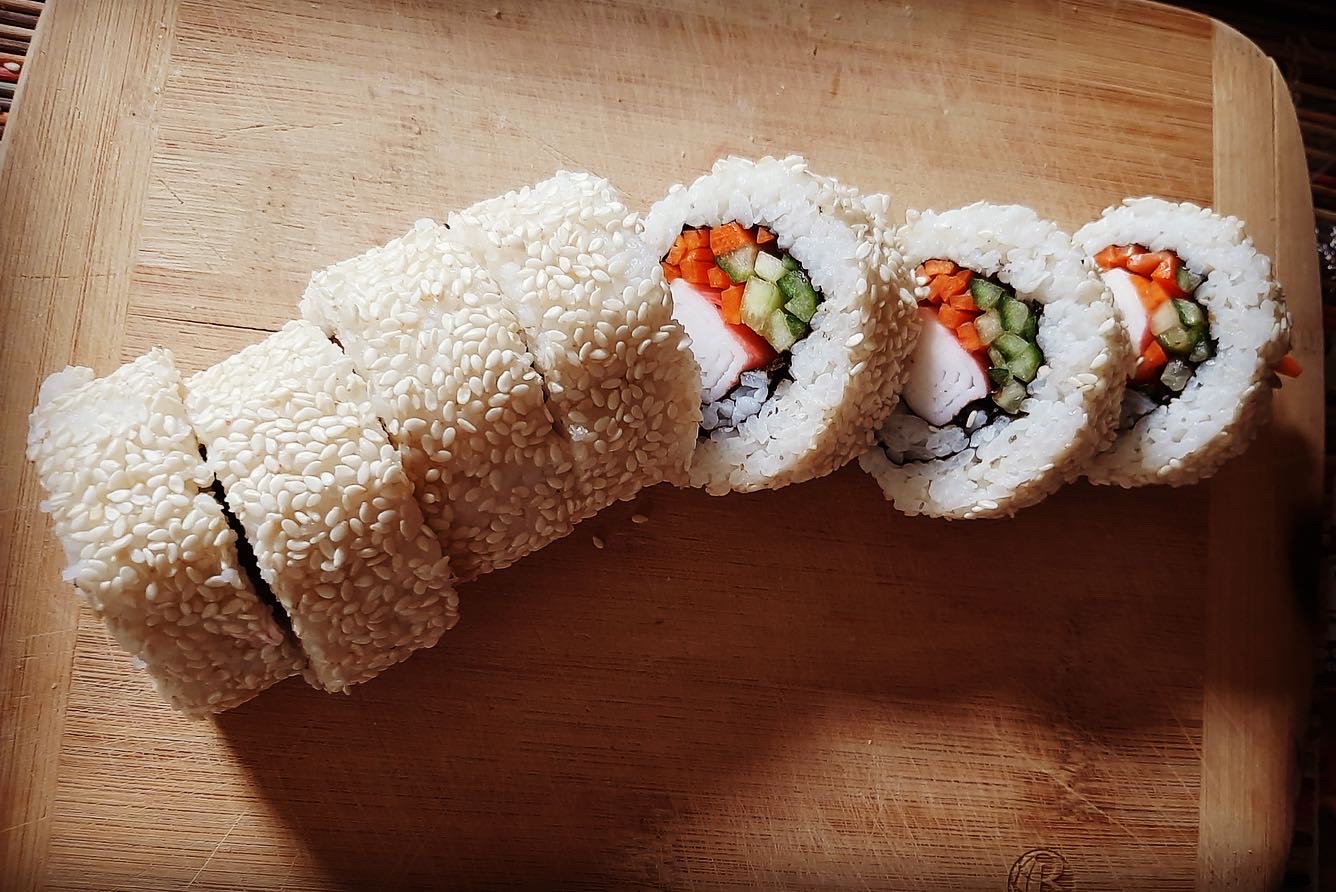
Ms. Kawaguchi began by discussing the history of onigiri, and she explained how onigiri differs from sushi, which more people are familiar with. While sushi is made with rice seasoned with vinegar, sugar, and salt, onigiri is prepared with plain or lightly salted steamed rice.

Sushi
Sushi
To make onigiri, all you need is Japanese short-grain rice, which is often labeled as sushi rice. It's important to use short-grain rice, because other types of rice, such as long-grain jasmine rice, will not stick together.


After you cook the rice, wet your hands with water so the rice doesn't stick to your hands, shape a handful of rice into a triangular shape with your hands, and you have a basic onigiri! 

There are endless ways to make variations of onigiri. Wrapping nori seaweed around onigiri is common, and you can add fillings to the middle of your onigiri before shaping it if you'd like. Popular onigiri fillings include canned tuna with mayonnaise, umeboshi (Japanese pickled plum), and okaka (bonito flakes mixed with soy sauce). Ms. Kawaguchi said leftovers are great to fill onigiri. Add some flavor to the rice if you'd like, such as by mixing in some salt or furikake rice seasoning. You can be creative by molding the rice into different shapes, and they even sell molds to make fun onigiri animals and characters.

Onigiri
Onigiri is best enjoyed at room temperature and the day it's made. Making onigiri is a lot simpler than I thought it would be! For some more reading and entertainment:

Monday, January 16, 2023

Asian Cakes

Lately I have been missing Asian baked goods and snacks that remind me of my childhood. Since I don't live or work near an Asian bakery, I decided to take matters into my own hands! 

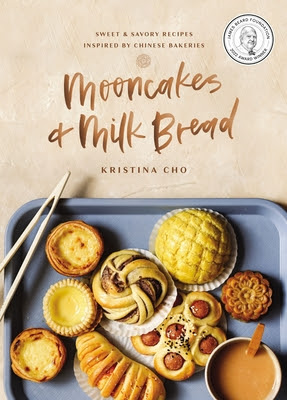
I took out the book Mooncakes and Milk Bread: Sweet and Savory Recipes Inspired by Chinese Bakeries by Kristina Cho from the library. Author Kristina Cho is a food blogger, and she shares recipes on her blog Eat Cho Food. Her book was a 2022 James Beard Award Winner for the Baking and Desserts and Emerging Voice categories.


I made the Fruit Cream Cake, which is a cake we often had for birthdays in my family when I was young. It's made with vanilla Chinese sponge cake, whipped cream frosting, and fruit.

Chinese Fruit Sponge Cake

The cake is very light and not too sweet, and whipped cream frosting is my favorite.

Another light cake that I just learned about is the Japanese steamed cake, Mushi-pan. These cakes are steamed and not baked. Steaming was a common cooking method in my household when I was growing up. I learned about Mushi-pan and found the recipe online at Just One Cookbook, a website featuring Japanese recipes by Namiko Hirasawa Chen (Nami).

The steamed cake recipe contains only a few ingredients, is quick to make, and is easy to adapt! So far I have made the basic steamed cake and the corn and cheese steamed cake. However, Nami also has recipes for a double chocolate steamed cake and a matcha green tea steamed cake that I need to try. Mushi-pan is a delicious snack.

Basic Steamed Cake, Mushi-Pan

Corn and Cheese Steamed Cake

I can't wait for my next cooking adventure! 😋

Sunday, October 23, 2022

From Seed to Table

In my previous position as Assistant Food Service Director for Hingham Public Schools, I had the wonderful opportunity to lead the Hingham High School Farm to School team. One of my responsibilities in that role was to grow lettuce for the high school cafeteria lunches!

At the high school, we grew lettuce with the EvanLEE Organics' Grow Towers, which are indoor growing racks. We had grow towers in the cafeteria kitchen, classrooms, and even the high school greenhouse.

The grow towers use a terraponic system. In this system, plant trays are planted with soil and seeds as usual, but instead of watering the soil directly, water is added to the water pan that the trays rest in. Holes in the bottom of the planted trays allow the soil and plants to take up water as needed.


Students and staff helped to plant, maintain, harvest, and serve the greens that we grew. The lettuce was offered in the high school cafeteria lunches and donated to the Hingham Food Pantry. I enjoyed working with the community to offer fresh, delicious, and nutritious meals. In the 2019-2020 school year, we served over 150 pounds of our own organically grown lettuce!

To learn more about the EvanLEE Organics' Grow System at Hingham High School, please watch this video.

Sunday, March 6, 2022

Inspiring Reads

I am very excited to be working at the Wellesley, Dedham, and Westwood Public Libraries! Lately I have been reading inspirational books, and I have found them to be so hopeful, thought-provoking, and motivational that I wanted to share some with you.

The Book of Joy: Lasting Happiness in a Changing World
by His Holiness the Dalai Lama and Archbishop Desmond Tutu, with Douglas Abrams 

How do you find joy in life with the difficulties we face everyday and all of the suffering in the world? Spiritual leaders Archbishop Tutu and the Dalai Lama meet for a week in Dharamsala, India, to discuss how they live joyful lives through their different practices, and how you can do it yourself. 

Peace is Every Step: The Path of Mindfulness in Everyday Life
by Thich Nhat Hanh

Vietnamese Buddhist Zen Master and peace activist Thich Nhat Hanh shares his stories and wisdom, to teach us how to increase our awareness and find peace in every moment even during stressful times.

The Book of Hope: A Survival Guide for Trying Times
by Jane Goodall and Douglas Abrams

It is not easy to feel hopeful with the global climate crisis that is affecting humans, animals, and the environment. Through Jane Goodall's experiences and conversations with Douglas Abrams, discover more about hope, Jane's four reasons for hope, and Jane's thoughts on how we can live in harmony with nature.

The Gift of Anger: And Other Lessons from My Grandfather Mahatma Gandhi
by Arun Gandhi

Arun Gandhi recounts living with his renown grandfather, Mohandas “Mahatma” Gandhi for two years, when he was just twelve years old. Each chapter provides a different lesson on how to live peacefully and create positive change in the world.

Happy Reading!

Friday, February 25, 2022

Fermentation: Make Your Own Sauerkraut!

If you are interested in making your own fermented foods and don't know where to start, sauerkraut is a great first project. It's very easy and requires only two ingredients: cabbage and salt. Here I will share with you how to make your very own sauerkraut!


Sauerkraut Recipe

Ingredients and materials
  • Cabbage, shredded (1 pound per pint jar)
  • Sea salt or Himalayan salt (2 teaspoons per pound of cabbage)
    • Please note: do not use iodized salt
  • Glass jars (for example, wide mouth 1-pint mason jars)

Directions
  1. Add the shredded cabbage and 2 teaspoons salt per pound of cabbage in a mixing bowl.
  2. Mix and knead the mixture until the cabbage releases its juices.
  3. Tightly pack the mixture into clean glass jars and leave at least an inch of headroom at the top.
  4. Cover the jar(s) loosely and place in an undisturbed, dark spot if possible.
  5. Press the sauerkraut down once a day, so that the liquid rises above the top of the kraut. 
  6. Let the cabbage ferment for 4-5 days, then taste the kraut. If you like the taste, store the sauerkraut in the fridge. Otherwise, continue to ferment for as long as you would like. The sauerkraut can be stored in the fridge for many months.
    • Tip: I usually like to ferment my sauerkraut for about a week, because the liquid in the sauerkraut tends to evaporate off over time, and the cabbage should be submerged in liquid during fermentation. But adjust the fermentation time depending on your personal preference, the environment, and your experience.
  7. Enjoy the sauerkraut when it's done!
Variations
  • Add Color: Try combinations of white and purple cabbage, or add some other root vegetables, such as carrots, beets, turnips, etc.
  • Add Spices: Caraway, anise, and fennel are all good candidates. Add 1 teaspoon per pound of cabbage, or more or less according to taste.
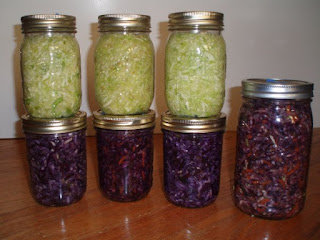
Sauerkraut made with green cabbage (top jars) and red cabbage, carrots, and caraway (jars below and to the right)

Fermented foods may provide health benefits, such as boosting the immune system, decreasing inflammation, and more.


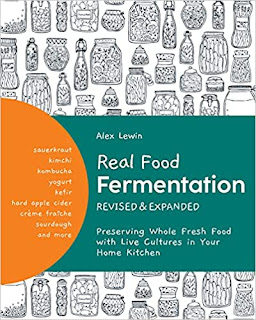
Looking for more fermentation projects? Check out the book Real Food Fermentation by Alex Lewin, which has just been released with a revised and expanded second edition. Learning how to make sauerkraut from Alex at a Slow Food BU workshop in 2009 was how I first got inspired to make it on my own at home! The book covers how to ferment foods and beverages of all kinds, with beautifully illustrated step by step photos. And if you enjoy the fermented tea kombucha, don't forget to read my contribution in the book with tips on the kombucha "mother," which is also known as a SCOBY, or symbiotic culture of bacteria and yeast.

Happy Fermenting!

Sunday, May 2, 2021

Bread Baking

What's better than a homemade loaf of bread? Here I will share with you three bread recipes that I love to make.

First is one of the most recent bread recipes that I learned about. It's a homemade Italian bread, that produces a soft and fluffy loaf. It doesn't require kneading and takes only a little over 2 hours to make, so it's a great recipe when you're short on time! Find the recipe here from Amanda's Cookin'

Homemade Italian Bread

Next is Cook's Illustrated Almost No-Knead Bread. It involves very little kneading, but it does require some planning ahead, with a first rise of 8-18 hours and a second rise of 2 hours. The bread is cooked in a dutch oven, initially with the lid on, and then cooked for the last 10-15 minutes with the lid off. It makes a loaf with a very crunchy crust, which is delicious! Learn how to make the Almost No-Knead Bread here. Pictured below is the white flour recipe, which is the one I usually make. 

Almost No-Knead Bread

Finally there is my fiancé's great-grandmother's bread recipe. This recipe uses a traditional hand kneading method, with a first rise of 1.5 hours and a second rise of 1.5 hours. The recipe yields three, traditional white bread loaves. We made this bread for my fiancé's grandmother a few weeks ago when we celebrated her 101st birthday, and she loves to eat this bread that she used to make when she was younger! The recipe is below. Since cake yeast isn't readily available, I substitute the 1 cake yeast with 2 tablespoons and 3/4 teaspoons dry yeast. 

Great-Grandmother's White Bread

Great-Grandma's White Bread Recipe

Grandma's 101st Birthday!

I hope these recipes have inspired you to go and bake some bread! :)

Tuesday, April 21, 2020

The Cranberry Bog and Nature Trail at Patriot Place

Hidden behind Patriot Place is a hidden Ocean Spray Cranberry Bog and Nature Trail! This 7-acre bog is the last active cranberry bog in Foxborough, MA.


Fun cranberry facts
  • Did you know that cranberries are one of the few fruits originally native to North America?
  • Cranberries do not grow in water. They grow on vines, and air pockets inside fresh cranberries allow them to float on water.
  • Cranberries may be dry or wet harvested in the fall. In the dry harvest method, a mechanical picker harvests the cranberries from the vines. With the wet harvest method, cranberry bogs are flooded with water, and water reels mix the water loosening the berries from the vines. The cranberries can then be gathered together, because they float on water.
  • Only around 5% of cranberries are sold fresh while the other 95% are sold as cranberry sauce, juice, dried cranberries, and more.
  • Around 400 million pounds of cranberries are consumed by Americans a year! Almost 80 million of these pounds are eaten during the week of Thanksgiving.
  • There are numerous health benefits associated with eating cranberries. They contain antioxidants, vitamins, minerals, and fiber, including vitamin C. Cranberry consumption may also reduce the risk of developing urinary tract infections.

Learn more about cranberries and the bog when you walk along the 1/2 mile trail at Patriot Place. It's open from dawn to dusk, 7 days per week, at 1 Bass Pro Drive, Foxborough, MA.

Sources:

Friday, August 9, 2019

Mindfulness at MorningSun

This past July my fiancé and I went on a Treasure of Life Mindfulness Retreat at MorningSun Mindfulness Center in the Plum Village tradition. Plum Village is a Buddhist monastery in France founded by Zen Master Thich Nhat Hanh (Thay). The goal of the Plum Village community is to create "a healthy, nourishing environment where people can learn the art of living in harmony with one another and with the Earth."

Likewise, the MorningSun community in New Hampshire strives "to be a resource for people working to create a better world by sharing practices that can build peace, and develop vital and thriving relationships between individuals, families, organizations and the Earth." MorningSun was co-founded by Fern Dorresteyn and Michael Ciborski, who lived and trained at the Plum Village monastery for nine years.


The four day retreat was busy, with activities beginning at 7 am and ending at 9 pm. We had daily Dharma talks to learn more about the Plum Village tradition and ways to practice mindfulness, being aware and present in the moment. There were multiple opportunities for meditation everyday, including sitting meditation, working meditation, and walking meditation. The bell of mindfulness notified us when the next activity was going to start, but it was also used as a reminder for everyone to stop what they were currently doing, be aware of our breathing, and take the moment to relax and be mindful. From 9 pm until after breakfast the following morning, we had periods of noble silence to cultivate mindfulness, awareness, and to wind down at the end of the day.


One of the enriching aspects of this retreat was that it was an all ages retreat. There was a separate children's program for certain periods, and other times the entire community practiced together. Tasty vegan and vegetarian meals were prepared and shared with the MorningSun community, and we often ate at the picnic tables by Blueberry Pond.

Blueberry Pond
If you are interested in learning more about MorningSun Mindfulness Center and Plum Village, visit their websites. Other mindfulness centers and resources in the Plum Village tradition can be found on the Other Resources page!

Thursday, July 26, 2018

19th Annual Harvard Nutrition and Obesity Symposium: Sugar


The 19th Annual Harvard Nutrition and Obesity Symposium was held on July 11th and 12th. This year’s topic was Sugar: Epidemiologic, Physiologic, and Policy Considerations of the Sugar Epidemic.

The 19th Annual Harvard Nutrition and Obesity Symposium: Sugar
According to research from the National Cancer Institute, Americans consume around 22 teaspoons of added sugar per day, with ~50% of added sugar coming from beverages. Because sugar-sweetened beverages are the largest source of added sugar in the American diet, many studies have delved into this topic. Increased intake of sugary beverages has been associated with negative health effects, such as weight gain, obesity, cardiovascular disease, diabetes, metabolic syndrome, non-alcoholic fatty liver disease, gout, and tooth decay. Higher intake of sugary beverages has also been associated with decreased student academic performance, including the areas of grammar, reading, writing, and math.


To address some of the negative effects of sugar, a number of cities in the U.S. and other countries have added soda/sugar sweetened beverage taxes to discourage their purchase. Some have even taken it a step further, with junk food taxes added in Mexico and Hungary. Meanwhile, Chile is taking an impressive and large-scale approach to confront the obesity epidemic. High sugar beverages have a hefty 18% tax. Warning labels are put on the front of food and beverage packages with added sugars, sodium, saturated fats, or calories that surpass certain thresholds. Restrictions are placed on child marketing. In addition, there is a total advertising ban on all TV and cinema from 6 am – 10 am, with warning messages on TV outside of this time. 


Funds raised from sugar sweetened beverage taxes and similar taxes may be used for public health initiatives, such as supporting nutrition and physical activities in schools. Benefits of these taxes can include decreased consumption of unhealthy foods, decreased rates of overweight and obesity leading to healthcare cost savings, decreased mortality rates, increased number of quality of life years, and increased years of life for individuals.

Conflicting results have been found regarding whether low/zero calorie sweeteners are better or not compared to caloric sweeteners. Dr. Richard Mattes suggested that rather than lumping  sweeteners into a category, each type of sweetener presents a unique metabolic challenge. Taste receptors are located all over the body, and the signaling cascades they initiate vary depending on the sweetener type and where it binds to in the body. Dr. Eran Elinav noted how the human microbiome varies according to the individual, and how consumption of the same food or beverage has different effects on different people.

Overall, the fewer added sweeteners you consume, the better it is for your health. Different guidelines exist for recommended limitations on added sugar intake. The 2015-2020 Dietary Guidelines for Americans suggests limiting added sugars to less than 10% of total caloric intake. The American Heart Association recommends an intake of no more than half of one’s daily discretionary calories to come from added sugar. For most women, that's approximately 6 teaspoons per day, or 100 calories from sugar. For men, it's about 9 teaspoons per day, or 150 calories. While it may be difficult to determine the amount of added sugars in your foods and beverages, changes are coming to nutrition facts labels. Added sugars are scheduled to be declared on nutrition facts labels by 2020 for large manufacturers and by 2021 for small companies. Some manufacturers have already begun updating their nutrition facts labels!

The New Nutrition Facts Label