Showing posts with label Books. Show all posts

Monday, January 16, 2023

Asian Cakes

Lately I have been missing Asian baked goods and snacks that remind me of my childhood. Since I don't live or work near an Asian bakery, I decided to take matters into my own hands! 

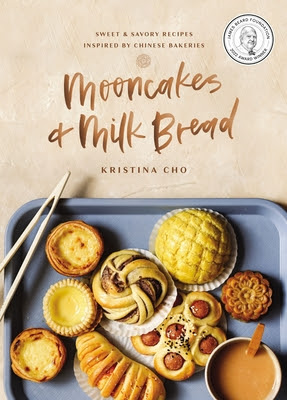
I took out the book Mooncakes and Milk Bread: Sweet and Savory Recipes Inspired by Chinese Bakeries by Kristina Cho from the library. Author Kristina Cho is a food blogger, and she shares recipes on her blog Eat Cho Food. Her book was a 2022 James Beard Award Winner for the Baking and Desserts and Emerging Voice categories.

I made the Fruit Cream Cake, which is a cake we often had for birthdays in my family when I was young. It's made with vanilla Chinese sponge cake, whipped cream frosting, and fruit.

Chinese Fruit Sponge Cake

The cake is very light and not too sweet, and whipped cream frosting is my favorite.

Another light cake that I just learned about is the Japanese steamed cake, Mushi-pan. These cakes are steamed and not baked. Steaming was a common cooking method in my household when I was growing up. I learned about Mushi-pan and found the recipe online at Just One Cookbook, a website featuring Japanese recipes by Namiko Hirasawa Chen (Nami).

The steamed cake recipe contains only a few ingredients, is quick to make, and is easy to adapt! So far I have made the basic steamed cake and the corn and cheese steamed cake. However, Nami also has recipes for a double chocolate steamed cake and a matcha green tea steamed cake that I need to try. Mushi-pan is a delicious snack.

Basic Steamed Cake, Mushi-Pan

Corn and Cheese Steamed Cake

I can't wait for my next cooking adventure! 😋

Sunday, March 6, 2022

Inspiring Reads

I am very excited to be working at the Wellesley, Dedham, and Westwood Public Libraries! Lately I have been reading inspirational books, and I have found them to be so hopeful, thought-provoking, and motivational that I wanted to share some with you.

The Book of Joy: Lasting Happiness in a Changing World
by His Holiness the Dalai Lama and Archbishop Desmond Tutu, with Douglas Abrams 

How do you find joy in life with the difficulties we face everyday and all of the suffering in the world? Spiritual leaders Archbishop Tutu and the Dalai Lama meet for a week in Dharamsala, India, to discuss how they live joyful lives through their different practices, and how you can do it yourself. 

Peace is Every Step: The Path of Mindfulness in Everyday Life
by Thich Nhat Hanh

Vietnamese Buddhist Zen Master and peace activist Thich Nhat Hanh shares his stories and wisdom, to teach us how to increase our awareness and find peace in every moment even during stressful times.

The Book of Hope: A Survival Guide for Trying Times
by Jane Goodall and Douglas Abrams

It is not easy to feel hopeful with the global climate crisis that is affecting humans, animals, and the environment. Through Jane Goodall's experiences and conversations with Douglas Abrams, discover more about hope, Jane's four reasons for hope, and Jane's thoughts on how we can live in harmony with nature.

The Gift of Anger: And Other Lessons from My Grandfather Mahatma Gandhi
by Arun Gandhi

Arun Gandhi recounts living with his renown grandfather, Mohandas “Mahatma” Gandhi for two years, when he was just twelve years old. Each chapter provides a different lesson on how to live peacefully and create positive change in the world.

Happy Reading!

Friday, February 25, 2022

Fermentation: Make Your Own Sauerkraut!

If you are interested in making your own fermented foods and don't know where to start, sauerkraut is a great first project. It's very easy and requires only two ingredients: cabbage and salt. Here I will share with you how to make your very own sauerkraut!


Sauerkraut Recipe

Ingredients and materials
  • Cabbage, shredded (1 pound per pint jar)
  • Sea salt or Himalayan salt (2 teaspoons per pound of cabbage)
    • Please note: do not use iodized salt
  • Glass jars (for example, wide mouth 1-pint mason jars)

Directions
  1. Add the shredded cabbage and 2 teaspoons salt per pound of cabbage in a mixing bowl.
  2. Mix and knead the mixture until the cabbage releases its juices.
  3. Tightly pack the mixture into clean glass jars and leave at least an inch of headroom at the top.
  4. Cover the jar(s) loosely and place in an undisturbed, dark spot if possible.
  5. Press the sauerkraut down once a day, so that the liquid rises above the top of the kraut. 
  6. Let the cabbage ferment for 4-5 days, then taste the kraut. If you like the taste, store the sauerkraut in the fridge. Otherwise, continue to ferment for as long as you would like. The sauerkraut can be stored in the fridge for many months.
    • Tip: I usually like to ferment my sauerkraut for about a week, because the liquid in the sauerkraut tends to evaporate off over time, and the cabbage should be submerged in liquid during fermentation. But adjust the fermentation time depending on your personal preference, the environment, and your experience.
  7. Enjoy the sauerkraut when it's done!
Variations
  • Add Color: Try combinations of white and purple cabbage, or add some other root vegetables, such as carrots, beets, turnips, etc.
  • Add Spices: Caraway, anise, and fennel are all good candidates. Add 1 teaspoon per pound of cabbage, or more or less according to taste.
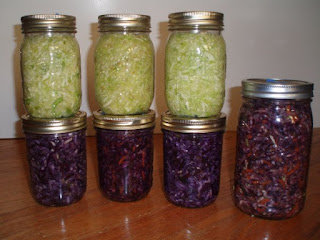
Sauerkraut made with green cabbage (top jars) and red cabbage, carrots, and caraway (jars below and to the right)

Fermented foods may provide health benefits, such as boosting the immune system, decreasing inflammation, and more.


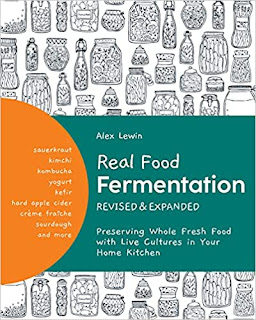
Looking for more fermentation projects? Check out the book Real Food Fermentation by Alex Lewin, which has just been released with a revised and expanded second edition. Learning how to make sauerkraut from Alex at a Slow Food BU workshop in 2009 was how I first got inspired to make it on my own at home! The book covers how to ferment foods and beverages of all kinds, with beautifully illustrated step by step photos. And if you enjoy the fermented tea kombucha, don't forget to read my contribution in the book with tips on the kombucha "mother," which is also known as a SCOBY, or symbiotic culture of bacteria and yeast.

Happy Fermenting!